

 |

Intercom, September 1998
Newsletter for Employees and Friends of Raritan Bay Medical Center, Perth
Amboy, NJ
Reproduced with permission
A hospital stay for any child can be frightening and
unsettling. Most children don't even understand why they are there. Raritan
Bay Medical Center's Pediatrics department is using a new technique to make
children feel comfortable and at ease in order to help speed recovery.
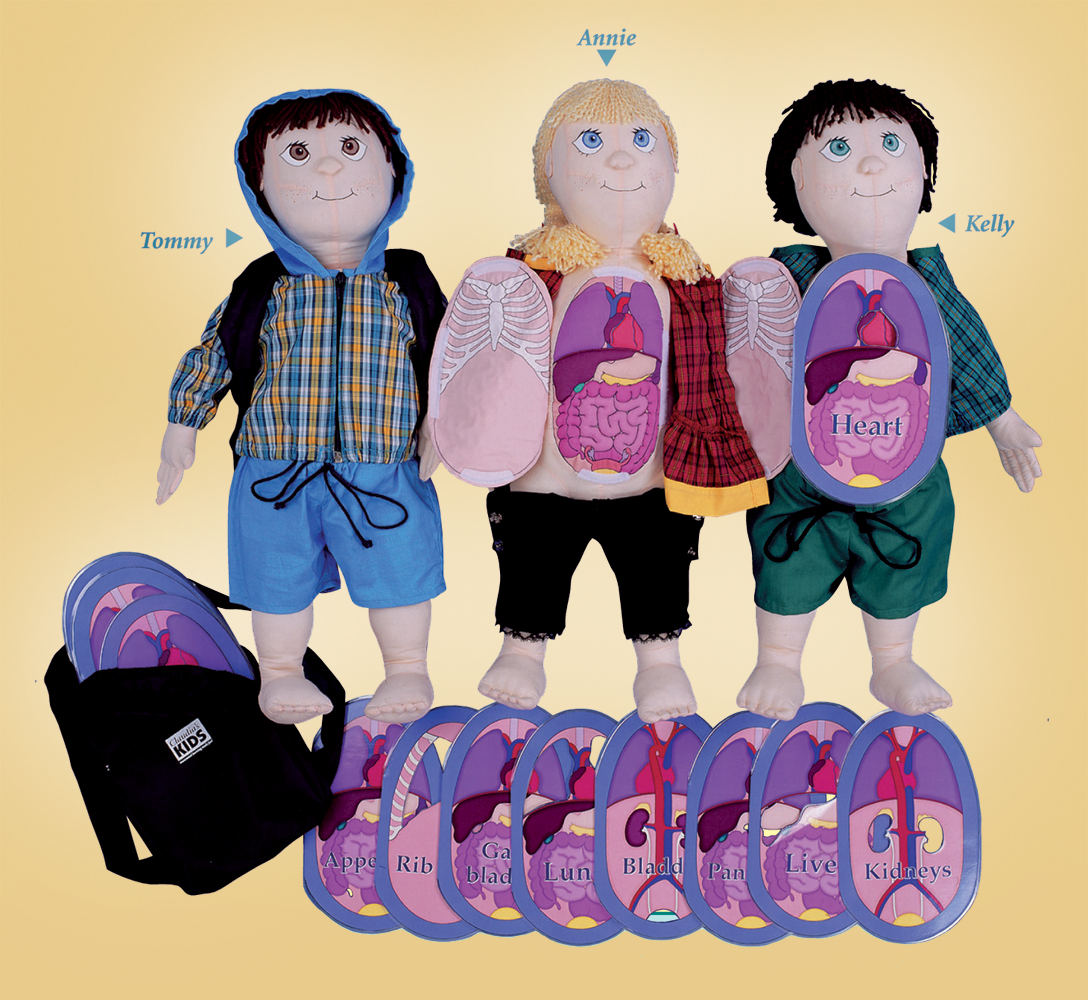
The Pediatrics department recently received a male and female anatomical
learning doll as a dontaion from the Perth Amboy Junior Auxiliary. These
cuddly and educational dolls, better known as "Claudia's Kids,"
are designed to satisfy the overwhelming fascination and curiosity children
have about their bodies. Anatomical information is presented in a safe,
non-threatening manner that is geared to the minds of children.
The dolls are designed to appeal to both pre-school and elementary school
aged children. Flaps on the tummy and back can be opened to expose dimensional,
realistic looking organs and skeletal structures. Each doll comes with a
backpack filled with colorful teaching templates, which help tell the story
of what goes on inside the body. Each template can be superimposed on the
doll to help find and identify an organ. Open the template and simple language
describes the organ and its primary function. Dressing and undressing the
dolls will even provide practice in buttoning, zipping and fastening.
"Each year the Perth Amboy Junior Auxiliary donates money to the
hospital," says Donna Tuttle, director of Volunteer Services. "This
year, they wanted to do something special for Pediatrics. The juniors purchased
the dolls with the fundraising money they made doing facepainting at the
Metuchen & St. James street fairs, selling their annual Thanksgiving
Pies and participating in several other events over the year."
"Claudia's Kids" are being used in approximately 200 hospitals
including internationally in Russia, Australia, Greece, Scotland and Israel.
Because the dolls teach about normal anatomy and physiology, they also are
being used in many schools, day care centers and homes, to help children
learn about their bodies.
"These dolls are terrific, they teach children about their bodies
and how their bodies function," says Johnetta Matkowsky, RN, patient
care coordinator of Pediatrics. "Doctors and nurses use them as teaching
aids for children and parents."
Milwaukee Jornal Sentinel, October 6, 1998
Health/Science Section
By Neil D. Rosenberg
©1997 Jounal Sentinal Inc., reproduced with permission.
Some dolls cry. Some wet. Some crawl. Some talk.
And some show off their body parts.
That one would be one of Claudia's Kids, soft-sculptured dolls that
show off everything from liver to kidneys, from ovaries to testicles.
The dolls are the brain-child and creation of Claudia Grosz, a medical
illustrator, whose parents, Sandy and Robert Grosz of Greendale, are marketing
and selling the dolls out of their home under the name Grosz Anatomy.
Designed as an educational tool the dolls are aimed at health educators
in hospitals, schools and clinics, although the Groszes also are trying
to break into the day care and home school market.
Sandy Grosz said the doll is aimed at satisfying the natural curiosity
of youngsters about their bodies and how they work. It also is useful to
health workers to help explain medical procedures or surgery to youngsters.
The dolls, which come in anatomically correct female, male and genderless
forms, have Velcro front and back panels. When opened, the panels reveal
the guts, literally, of the body, and other major internal organs and blood
vessels as well.
Templates, which highlight selected organs and open up book-style to
a basic explanation of the organ and how it works, are included.
Carol Bell, a child life specialist at Gundersen Lutheran Hospital in
La Crosse, has purchased two of the dolls -- female "Annie" and
male "Tommy."
"It is really a neat way of helping a little bit more in explaining
to kids where things are located in the body," said Bell, whose role
is both health educator and recereational specialist.
She recently used a doll to show the location of the appendix to a youngster
facing surgery to remove hers, and said the hospital uses the dolls at least
once a week for surgical cases.
The hospital also uses the dolls in cases in which children receive
medicine or nutrition through an intravenous line placed near the collarbone.
"The doll helps them trace how the blood flows in the body."
The hospital also is beginning to use the dolls in preschool and day
care situations, where children first become interested in their bodies.
Sandy Grosz said her daughter designed the doll as a final project in
a medical illustration master's program at the University of Michigan in
1992.
"She loves children and liked to sew" and the doll was a natural
outgrowth of that, Grosz said.


Association of Medical Illustrators Citation of Merit
Special recognition of achievement in medical illustration
Vesalius Trust Certificate of Merit
An award that recognizes creative individuals and their projects exhibiting
excellence and innovation in the area of visual communication in the health
sciences

Dolls have met the safety requirements of ASTM F963 and European Standard
EN71

|